
How to Track Your Menstrual Cycle
What to record about bleeding, pain, symptoms and possible signs of ovulation
WOMEN’S HEALTH RESOURCE
Cycle tracking can provide much more useful information than knowing when your next period is due.
Recording when bleeding begins, how your symptoms change and whether patterns repeat can help you understand what is usual for you. It can also make healthcare appointments more productive when you are experiencing painful periods, heavy bleeding, irregular cycles, premenstrual symptoms or fertility concerns.
You don’t need to record every sensation or produce a perfect chart. I only want you to collect enough consistent information to see the pattern more clearly.
Start with the basics
A useful cycle record does not need to be complicated. Begin with the dates of your period, your bleeding pattern and the symptoms that matter most to you. More detailed fertility signs can be added later if they are relevant.
What counts as cycle day one?
Cycle day one is generally the first day of proper menstrual flow, not one or two spots of brown or pink discharge before the period begins.
If you notice light brown spotting on Monday but your usual menstrual flow begins on Wednesday, Wednesday would be recorded as cycle day one. Your cycle continues until the day before your next period begins. If your next period starts on cycle day 29, the previous cycle was 28 days long.
If you have been given specific instructions for timed blood tests, fertility treatment or an ultrasound, follow the definition provided by that clinic because its timing requirements may differ.
Choose a tracking method you will actually use
You can use a period-tracking app, your phone calendar, a paper diary or a simple spreadsheet. The method matters less than recording the information consistently.
For general cycle tracking, I use the My Cycle app. This is suitable for recording period dates and the overall cycle pattern.
When basal body temperature or more detailed ovulation signs are being tracked, I use Kindara. Kindara allows temperature, cervical mucus and other fertility signs to be viewed together on a chart.
Remember that an app’s predicted period or ovulation date is an estimate based on the information entered. It is not proof of when ovulation occurred.
The minimum useful cycle record
If detailed tracking feels overwhelming, begin by recording:
The first day of proper menstrual flow
The final day of bleeding
Whether the bleeding was light, moderate or heavy
Any pain and how much it affected your day
Any symptoms that repeatedly occur before or during your period
This is enough to begin identifying a pattern.
What to record each cycle
The most useful record describes what actually happened rather than relying on labels such as “normal,” “bad” or “heavy.” Dates, timing and the impact on your day provide the clinical picture needed to understand the pattern.
Record your bleeding pattern
Record the first and final day of bleeding, any spotting before or after your period and any bleeding that occurs between periods or after sex.
You don’t need to measure the exact volume of blood. Instead, note whether the flow was light, moderate or heavy and how frequently you needed to change your pad, tampon, menstrual cup or period underwear.
Also record any flooding, bleeding through clothing or bedding, and the approximate size and frequency of clots.
“Changed a regular tampon every three hours” is more informative than simply recording “heavy.”
Heavy menstrual bleeding may include needing to change a period product every one to two hours, bleeding through clothing, passing clots larger than approximately 3 cm, bleeding for longer than eight days or having bleeding that interferes with normal activities.
Track pain by its impact, not only a number
A score out of ten can be useful, but it doesn’t tell us everything we need to know.
Record when the pain begins in relation to your period, where it is located and how long it lasts. Note whether it travels into your back, legs or rectum, or occurs during bowel movements, urination or sex.
Also record accompanying symptoms such as nausea, vomiting, dizziness or faintness, along with any pain relief you use and whether it works.
Most importantly, describe the impact. Did you need to miss work, cancel exercise, remain in bed or change your usual activities? Did the pain wake you or prevent you from sleeping?
Pain that repeatedly disrupts your normal activities deserves assessment, even if you have previously been told that period pain is normal.

Track patterns, not every symptom
Symptoms become more meaningful when their timing is recorded. A headache that consistently occurs the day before your period is different from headaches that occur randomly throughout the month.
Depending on your health concerns, you may choose to track mood, energy, sleep, headaches, breast tenderness, bloating, bowel changes, pelvic pressure, acne, appetite, vaginal discharge or pain during sex.
You do not need to track all of these. Choose the symptoms most relevant to you and record when they begin, when they are at their worst and when they settle.
Use a simple symptom scale
A basic four-point scale makes changes easier to identify without requiring you to analyse every sensation:
0 – None: The symptom was not present
1 – Mild: Noticeable but did not affect normal activities
2 – Moderate: Affected comfort, concentration or usual activities
3 – Severe: Prevented normal activities or required significant pain relief or rest
Add relevant information
Include a brief note when illness, fever, major stress, travel, disrupted sleep or a substantial change in exercise occurs.
It is also useful to record changes in medication, hormonal contraception, food intake or weight, as well as pregnancy, birth, breastfeeding, weaning or fertility treatment.
These factors do not automatically explain a change, but they can make the overall pattern easier to interpret.
How long should you track?
Aim to record at least two to three cycles where possible.
One cycle provides a snapshot. Several cycles make it easier to see whether a symptom follows a repeated pattern or was an isolated change.
If your cycles are very long, absent or highly irregular, do not postpone seeking care simply because you have not collected several months of information. Bring whatever you have.
Optional: tracking possible ovulation
Not everyone needs to track ovulation.
It may be useful when trying to conceive, investigating irregular or absent cycles, or recording cycle patterns as part of a personalised treatment plan.
Possible signs include changes in cervical mucus, a urinary luteinising hormone test and a sustained change in basal body temperature. Each provides different information, and no single sign gives a complete assessment of fertility or hormone health.
Cervical mucus changes
Cervical mucus often changes as oestrogen rises before ovulation. You may notice it becoming progressively wetter, clearer, more slippery or more stretchy as the fertile window approaches.
Discharge can also be affected by infections, vaginal products, semen, medications, breastfeeding and hormonal contraception.
Seek medical advice if discharge develops an unusual odour or is accompanied by itching, burning, pelvic pain or other concerning symptoms.
Ovulation predictor tests
Ovulation predictor tests detect a rise in luteinising hormone, often called the LH surge.
A positive test suggests that ovulation may be approaching, but it does not prove that an egg was released. Some people experience more than one LH rise, and certain hormonal conditions can make results more difficult to interpret.
Follow the instructions for your particular test and record the result rather than relying only on an app’s interpretation.
Basal body temperature tracking
Basal body temperature, or BBT, is your resting temperature measured immediately after waking.
Progesterone produced after ovulation usually causes a small rise in temperature. When relatively lower temperatures are followed by a sustained higher pattern, the chart may be consistent with ovulation having occurred.
BBT is retrospective. The rise occurs after the fertile days have largely passed, so it cannot reliably predict ovulation in advance. It also does not directly measure progesterone or overall “hormone balance.”
Some ovulatory cycles do not produce a clearly biphasic chart. Temperature should therefore be interpreted as one piece of information rather than definitive proof of ovulation.
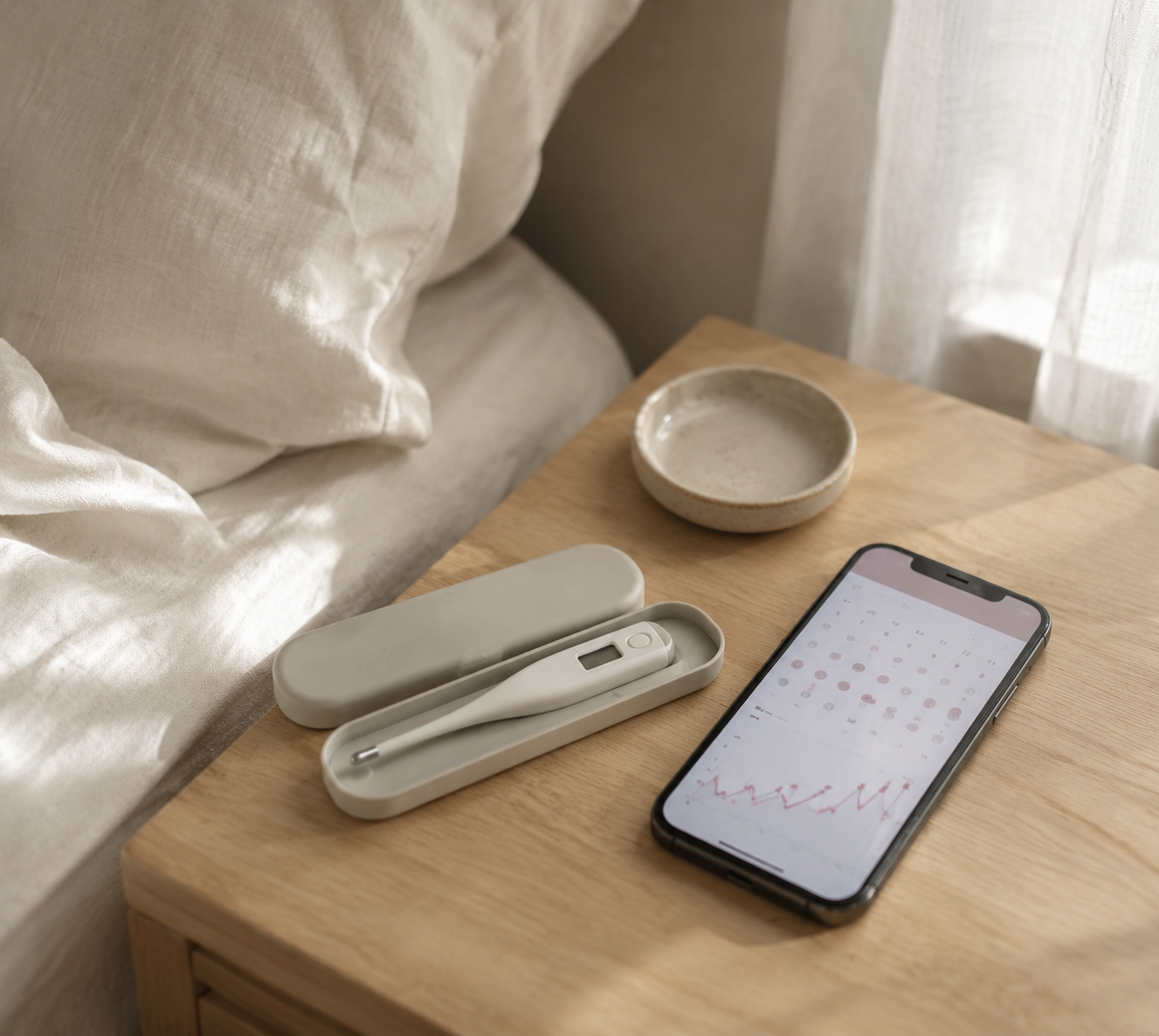
What you need
I recommend the Welcare Digital Ovulation Thermometer, which measures temperature to two decimal places and is available from Chemist Warehouse.
A standard fever thermometer may display only one decimal place and may not capture the small temperature changes used in BBT charting. You don’t need an expensive wearable or Bluetooth thermometer. Another brand is suitable if it is designed for basal temperature tracking, measures in degrees Celsius to two decimal places and can be used consistently each morning.
I use the Kindara fertility-tracking app to record and review temperature charts. The free version is all that is required.
How to take and record your temperature
Keep the thermometer beside your bed. Take your temperature immediately after waking, before getting out of bed, talking, drinking water or beginning your morning routine. Use the thermometer in the same way and measurement location each day, following its instructions.
Try to measure at approximately the same time where practical. Enter the reading into Kindara or your chosen chart.
Add a note if your sleep was disrupted, you woke significantly earlier or later than usual, you were unwell or another factor may have affected the result. Missing an occasional day is not a problem. Continue with your usual routine the following morning rather than estimating the missing temperature.
What can affect a temperature reading?
Illness, fever, disrupted sleep, shift work, alcohol, travel, waking at a different time and some medications can all affect a reading. Do not automatically discard an unusual temperature. Record the possible reason and assess the pattern across the cycle rather than focusing on one number.
What are we looking for?
A typical biphasic chart shows relatively lower temperatures before ovulation, followed by a small rise that remains generally higher through the luteal phase. Real charts rarely look perfectly smooth. Individual temperatures naturally move up and down, and the useful information comes from the overall pattern across several days and cycles.
A chart without an obvious temperature rise does not by itself diagnose anovulation, low progesterone or infertility. Further assessment may be needed if ovulation remains uncertain or cycles are persistently irregular.
When cycle tracking may look different
Cycle patterns and ovulation signs are affected by life stage, medication and hormonal contraception. Tracking can still be useful, but the information may need to be interpreted differently.
Hormonal contraception
Hormonal contraception changes the natural hormone pattern and may suppress ovulation.
Bleeding while taking the combined oral contraceptive pill is generally a withdrawal bleed rather than a natural menstrual period. Hormonal IUDs, implants, injections and progestogen-only pills may also change bleeding frequency, flow and ovulation.
You can still track bleeding, pain, mood, headaches and other symptoms, but temperature and ovulation signs may not be interpretable in the same way as during an unmedicated cycle.
Always record the type of contraception you use when sharing your cycle history with a healthcare practitioner.
Breastfeeding and perimenopause
Cycles may become less predictable during breastfeeding and perimenopause.
Rather than focusing on whether every cycle fits an expected length, record bleeding, spotting, changes in flow and any symptoms affecting your quality of life.
During perimenopause, this may include hot flushes, night sweats, sleep changes, headaches, mood changes and vaginal or urinary symptoms.
Cycle tracking is not contraception
An app prediction, temperature chart or estimated ovulation date should not be relied upon alone to prevent pregnancy.
Fertility-awareness-based contraception requires a defined method, accurate daily observations and appropriate instruction. If avoiding pregnancy is important, discuss reliable contraceptive options with a qualified healthcare professional.
What to bring to an appointment
You do not need to arrive with a perfect or completely filled chart. Bring whatever information you have been able to record.
The most useful details include:
Two to three completed cycles, if available
The dates of your most recent periods
Your usual cycle length and how much it varies
Notes about bleeding, spotting, pain and relevant symptoms
Any BBT, cervical mucus or ovulation-test results you have collected
Screenshots from My Cycle are suitable for general cycle tracking. If you have also been recording temperatures or ovulation signs, bring or send your Kindara chart as well.
Reviewing your cycle record
Tracking should not be stressful and does not need to be perfect.
Several cycles can be reviewed alongside your symptoms, health history, contraception, medications, blood results and relevant investigations to determine what may need further assessment.
If you are an existing client, follow the specific tracking instructions in your treatment plan and bring your record to your next consultation.