
NUTRITION RESOURCE
Eating Enough Protein:
A Practical Guide
How to recognise a meaningful protein serve and build it into everyday meals
Eating enough protein does not require a bodybuilding diet, enormous servings of meat or a protein shake with every meal.
What matters the most is whether your usual meals contain a meaningful amount of protein and whether your total intake is appropriate for your body, activity and current health needs.
This guide provides a flexible starting point. Your appetite, food preferences, budget, digestion, activity and treatment goals may all change what enough protein looks like for you.
Protein supports more than muscle
Protein provides amino acids that the body uses to maintain and repair tissues and to produce enzymes, transport proteins, antibodies and many other important compounds.
It is particularly relevant for maintaining muscle, strength and physical function, as well as supporting recovery from exercise, illness and injury. Protein can also help make meals more satiating.
However, eating more protein does not automatically correct fatigue, “balance hormones,” increase metabolism or produce weight loss. Adequate energy, varied plant foods, resistance exercise, sleep and the wider health picture still matter.
HOW MUCH PROTEIN DO YOU NEED?
There is no single number for everyone
Protein requirements are influenced by body size, age, activity, overall energy intake, health status and whether the goal is basic adequacy, recovery, muscle maintenance or muscle gain.
The Australian Recommended Dietary Intake for women aged 19–70 is 46 grams per day. This is a population benchmark for nutritional adequacy, not necessarily the amount that best supports an individual woman’s muscle, recovery, appetite or health goals.
PRACTICAL STARTING POINT
For many adult women, I generally work towards approximately 90–100 grams of protein per day.
Depending on body size, this often falls within approximately 1.2–1.6 grams per kilogram per day, a commonly used range when the aim extends beyond basic adequacy.
This does not mean that every woman requires exactly 90–100 grams. The appropriate amount depends on body size, age, activity, appetite, overall food intake, health conditions and individual goals.
Aiming for approximately 25–30 grams at breakfast and 25–35 grams at lunch and dinner, with smaller contributions from snacks and plant foods, can make this total much easier to reach.
You do not need to count protein indefinitely. Tracking a few ordinary days can help identify where the gaps are, after which the aim is to build a familiar and sustainable eating pattern.
People with kidney disease or another condition requiring protein modification should follow their medical and dietetic advice rather than a general online target.
BREAKFAST
Breakfast is where many people fall short
Breakfast is not metabolically magical, and the total amount eaten across the day remains important. It is simply the meal where many people consume the least protein.
In practice, breakfast is often the first meal I look at because improving it can correct a substantial gap without requiring the rest of the day to be completely redesigned.
Toast, cereal, fruit, porridge or a smoothie may contain some protein without providing very much. Even a breakfast that looks protein-rich can fall short of what someone assumes it contains.
Are two eggs enough?
Two eggs on toast is a breakfast I commonly see patients eating. It looks like a protein-rich meal, but it often provides less protein than people expect.
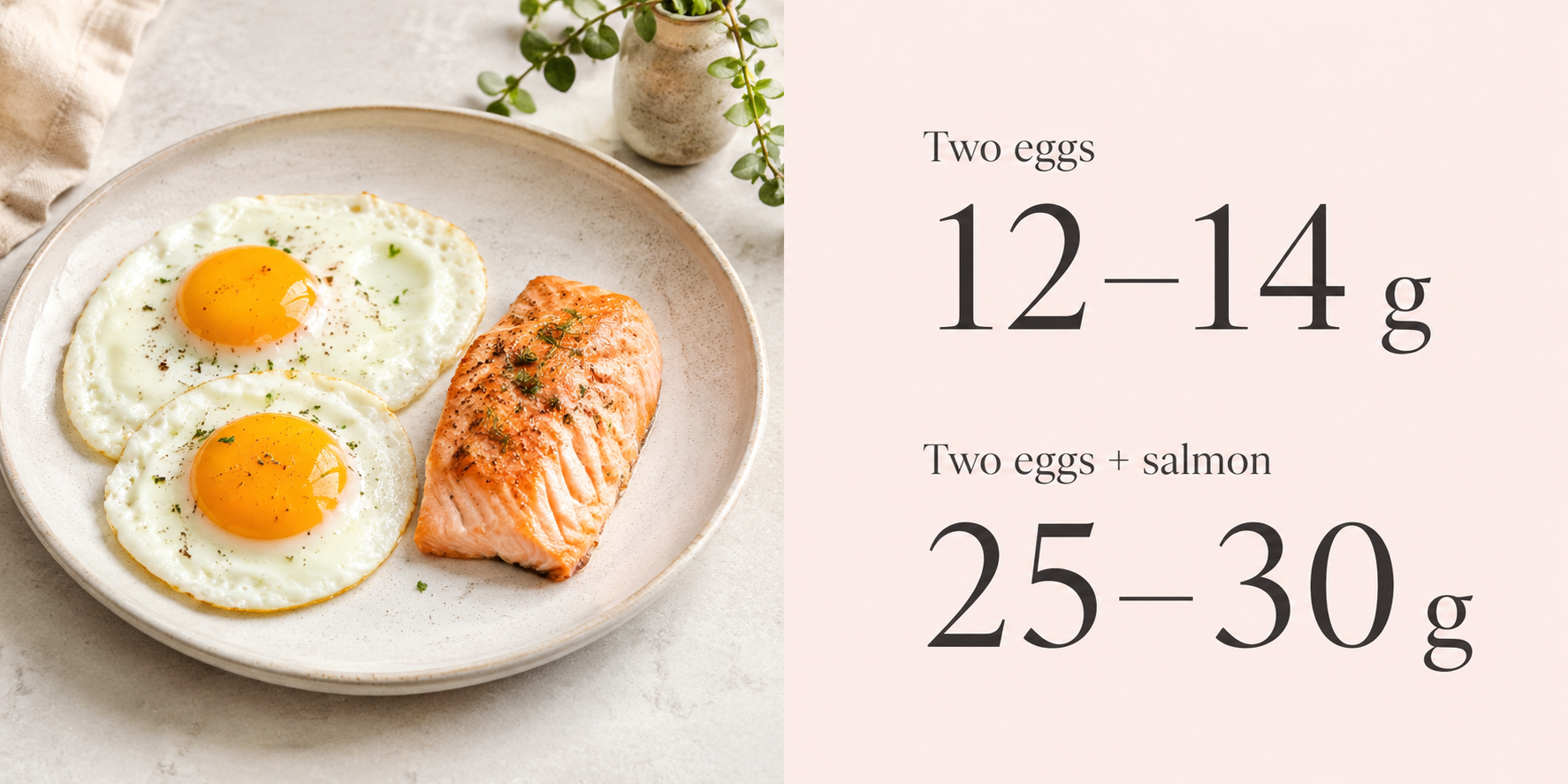
Two eggs provide approximately 12–14 grams of protein. They are nutritious and protein-containing, but for many adults they may not provide a substantial breakfast serve on their own.
Adding approximately 60–80 grams of fresh or leftover cooked salmon brings the eggs and salmon to roughly 25–30 grams of protein while also providing long-chain omega-3 fats.
Strengthen the breakfast you already eat
You do not need to eat salmon with your breakfast or abandon your preferred breakfast foods. Look for the simplest addition that makes it more substantial.
Add cottage cheese, beans or tofu to eggs
Choose a higher-protein yoghurt and add nuts, seeds, oats and fruit
Make porridge with dairy or soy milk and add yoghurt or a suitable protein powder
Build a smoothie around dairy or soy milk, yoghurt, silken tofu or protein powder rather than fruit alone
Use leftover salmon, chicken, tofu, tempeh or mince if you prefer a savoury breakfast
Breakfast does not need to look like conventional breakfast food.
WHAT DOES A MEANINGFUL SERVE LOOK LIKE?
Compare the amount, not just the food name
The values below are approximate. Protein content varies with the brand, variety, cooking method and actual portion size.
The visual descriptions are intended to help you recognise a practical serving without weighing every meal. They are guides rather than precise measurements because palm sizes, food products and packaged serving sizes differ.
Food and practical serving
Approximate protein
Two large eggs
12-14g
Palm-sized portion of cooked chicken, approximately 100g
28-32g
Palm-sized piece of cooked salmon, approximately 100g
22-25g
Palm-sized cooked steak, patty or portion of lean red meat, approximately 100g
25-30g
One small tub or approximately ¾ cup of Greek-style or high-protein yoghurt, approximately 200 g
15-20g
Approximately ⅔ cup of cottage cheese, around 150 g
17-20g
Approximately one-third of a standard block of firm tofu, around 150 g
18-24g
Approximately half of a standard block of tempeh, around 100 g
18-20g
One cup of cooked shelled edamame, approximately 155 g
16-18g
One cup of cooked lentils, approximately 200 g
16-18g
One cup of cooked chickpeas, approximately 165 g
14-15g
One standard glass of soy milk, approximately 250 mL
7-9g
One small handful of nuts, approximately 30 g
5-7g
½ cup of dry oats, approximately 40–45 g
5-7g
One serving of protein powder, commonly 25–35 g of powder
20-25g
Use the nutrition-information panel when comparing packaged products. Greek yoghurt, plant milks, tofu, tempeh and protein powders can differ considerably between brands.
Several foods contain some protein without providing a complete meal-sized serving on their own. Nuts, oats and soy milk all contribute, but they may need to be combined with another protein source when the aim is approximately 25–30 grams at a meal.
DISTRIBUTING PROTEIN ACROSS THE DAY
Total intake comes first, but distribution can help
Eating very little protein at breakfast and lunch and most of it at dinner is common.
The total amount eaten across the day remains the first priority. However, including a recognisable protein source at more than one meal can make an adequate intake easier to achieve and may better support muscle than relying on one very large evening serve.
This does not require eating every three hours or adding protein snacks when you are not hungry. Snacks are useful when they help meet your needs, but they are not compulsory if your main meals are sufficient.
PLANT FOODS AND PROTEIN
Plant foods contribute more than people realise
Legumes, tofu, tempeh, soy milk, whole grains, nuts, seeds and many vegetables all contribute protein. Some can form the main protein source of a meal, while smaller contributions from several foods add up across the day.
For example, oats made with soy milk and topped with chia seeds and nuts may provide a useful amount of protein before yoghurt, tofu or protein powder is added. The exact amount depends on the portions and products used.
Plant proteins still count. A varied plant-based diet can provide adequate protein, although portions and combinations may need more attention because some plant foods are less protein-dense than meat, fish, eggs or concentrated soy foods.
You do not need to perfectly combine complementary plant proteins at every individual meal. Eating a varied range of legumes, soy foods, whole grains, nuts and seeds across the day is more important.
Do not sacrifice plants to reach a protein target
Increasing protein should not mean replacing vegetables, fruit, whole grains, legumes, nuts and seeds with increasingly large portions of meat.
These foods provide fibre and a wide range of nutrients and plant compounds that protein-rich animal foods do not replace. If a meal needs more protein, the aim is generally to strengthen its protein source while keeping the varied plant foods around it.
Protein should not crowd out the carbohydrates needed for energy and training, the fats needed for a varied and satisfying diet, or the plant foods that provide fibre and wider nutritional value. A higher number is not automatically a better target, and protein cannot compensate for consistently inadequate food intake, poor sleep or the absence of resistance exercise when the goal is maintaining or building muscle.
WHEN PROTEIN-RICH FOODS FEEL HARD TO DIGEST
Digestive discomfort provides information
Some people describe meat or other protein-rich foods as sitting heavily, causing nausea, reflux, bloating, early fullness or abdominal discomfort.
If this happens repeatedly, it is important not to force larger servings. The pattern deserves attention because it may help identify what needs to be assessed or adapted.
However, symptoms after a protein-rich meal do not automatically prove that you have low stomach acid or cannot digest protein. The portion size, fat content, food type, cooking method, eating speed, chewing, constipation, reflux, medication and digestive motility may all be relevant.
When eating more feels unrealistic
A low appetite can make a large serving of protein feel impossible, particularly in the morning or during illness and digestive flares.
Instead of making the whole meal larger, choose a more concentrated or softer protein source and divide the total across several eating opportunities. Yoghurt, cottage cheese, eggs, fish, tofu, soy milk or a suitable protein powder may be easier than a large portion of meat, depending on the person.
Small additions can be more manageable than designing a completely new meal. This might mean adding yoghurt to porridge, tofu to a soup, salmon to eggs or milk or protein powder to a smoothie.
Persistent early fullness, nausea, vomiting, pain, unintentional weight loss, difficulty swallowing or difficulty eating enough requires appropriate medical assessment. Digestive enzymes or hydrochloric-acid supplements should not be used automatically on the assumption that digestion is weak.
PROTEIN POWDERS AND CONVENIENCE FOODS
Do you need a protein powder?
Protein powder is not essential and does not automatically provide something that food cannot. It can, however, be a useful convenience when appetite, time, dietary preferences or digestive tolerance make food targets difficult to reach.
The grams of protein per serve matter more than the size of the scoop or claims on the front of the package. Whey, soy, pea and blended plant proteins can all be useful, with the best choice depending on dietary preference, amino-acid profile, taste and tolerance.
Sweeteners, gums, sugar alcohols and added fibres can aggravate digestive symptoms in some people, so a longer ingredient list is not automatically better. Any protein powder, serving size and timing I recommend will be stated explicitly in the individual treatment plan.
What about protein bars and protein chips?
Many protein bars are closer to confectionery-style snacks with added protein than to a balanced food. I do not generally recommend relying on them as a routine way to meet protein needs.
When a portable option is needed, I would usually prefer edamame or simply seasoned beef jerky or biltong. Check the ingredients because jerky and biltong can vary considerably in added sugar, sodium and preservatives. As processed meats, they are best used as convenient options within a varied diet rather than as the main protein source every day.
Protein chips are still primarily a packaged snack. Added protein may change their nutrient profile, but it does not make them nutritionally equivalent to fish, eggs, yoghurt, tofu, tempeh, legumes or a balanced meal.
WHERE TO BEGIN
Start with one ordinary day
01 — Look at breakfast first.
Ask whether it contains a meaningful protein source or only a small contribution.
02 — Strengthen rather than replace.
Add an appropriate protein source while keeping the varied plant foods, carbohydrates and fats that make the meal complete.
03 — Use your individual target provided.
A practical intake you can maintain is more useful than chasing a perfect number for a few days.
If you are an existing patient, follow the protein target and recommendations in your treatment plan where they differ from this general guide.